

Advertising
Why Do Millions of American Workers Still Eat Cold Lunch in 2026? The Surprising Story Behind the "2-Minute Routine" That's Changing It

In 1950, a company called Aladdin Industries put a picture of a cowboy on a metal lunch box and sold 600,000 of them in a single year.
That box — steel, a clip latch, a matching thermos — became one of the most recognizable objects in American life. Before it, workers carried their food in tobacco tins, coffee cans, or a bucket with a lid. The "lunch pail" wasn't just a container. It became shorthand for an entire kind of person: the one who gets up before dawn, packs his own food, and goes to work with his hands.
Seventy-five years later, that person still exists. There are millions of them: long-haul truckers, framers and roofers, linemen, field technicians, warehouse crews, nurses running twelve-hour shifts.
And here's the strange part. Almost everything about their day has changed — the tools, the trucks, the phones in their pockets — except one thing.
At noon, most of them are still eating cold.
The Great American Lunch Paradox
Think about how odd this is.
You can heat your truck seat. You can heat your steering wheel. Your phone can order dinner to your driveway from a restaurant three towns over. But the meal your wife packed at 9 p.m. last night, sitting in a cooler bag next to you, is going to be 40 degrees when you open it at 12:15.
So you have three choices, and every worker who reads this knows them by heart.
- Eat it cold. Fork through congealed rice and rubbery chicken while telling yourself it's fine.
- Go hunting for a microwave. Maybe there's one in the break room, with a line of eight guys and a puddle of last week's soup on the turntable. Maybe there's one at the gas station, if the clerk lets you use it. On a job site or in a truck cab, there's nothing.
- Give up and buy something. Drive-thru, gas station hot case, food truck. Twelve, fifteen, sometimes twenty dollars. Five days a week.
Most people rotate through all three depending on the day. And most of them have made peace with it, because that's just how lunch works when you don't work in an office.
Except it doesn't have to.
Why Cold Food Actually Tastes Worse (It's Not in Your Head)
Here's something food scientists have understood for decades, but nobody ever tells the guy eating out of a cooler.
Temperature isn't just about comfort. It changes what your tongue can detect.
Your taste receptors are more sensitive to sweet and savory flavors when food is warm — which is part of why a warm slice of pizza and a cold slice from the fridge taste like two different meals. Aroma matters even more: the volatile compounds that carry most of a dish's flavor evaporate readily from hot food and barely at all from cold food. Food scientists estimate that a large share of what we call "taste" is actually smell. Cold food simply has less to give you.
Then there's what cold does to the food itself.
Cooked rice, pasta, and potatoes go through something called starch retrogradation as they cool. The starch molecules that softened during cooking slowly recrystallize, which is why yesterday's rice turns hard and grainy in the fridge. Heating it back up reverses the process — but only if it's heated properly, gently, and all the way through.
Fats are the other culprit. The sauce that was silky at dinner turns waxy and separates when it drops below about 90°F. That white film on cold chili or cold stew is fat that's solidified. It coats your tongue instead of carrying flavor.
None of this is a matter of preference. A cold lunch is objectively a worse version of the same meal. Which means the guy eating it is getting less enjoyment, and often less nutrition, because he leaves half of it in the box.
The Real Cost of "Just Grabbing Something"
Now let's talk about option three, because the numbers are bigger than most people think.
Say you buy lunch out three days a week and average $14 a stop. That's $42 a week, about $180 a month, over $2,100 a year. Do it five days a week at $15 and you're past $3,600 a year — on one meal.
That's a set of tires. That's a family vacation. For a lot of households, that's the difference between the month closing in the black or in the red.
And the food itself is, to put it kindly, not what a doctor would recommend for someone who spends the day lifting, climbing, and driving. A drive-thru combo is designed to be fast and cheap to produce, not to keep a 45-year-old electrician's blood sugar steady through a six-hour afternoon.
Most workers know all of this. The reason they do it anyway isn't laziness. It's that the alternatives have been genuinely bad for a very long time.
A Short History of Trying to Fix Lunch
People have been trying to solve the hot-lunch problem for over a century.
The vacuum flask — what we call a thermos — was invented in 1892 by a Scottish scientist named James Dewar, who needed to keep liquefied gases cold in his lab. Someone eventually figured out it worked in reverse for soup. It was a real breakthrough, and it's still the best tool we have for one specific job: keeping a liquid hot for about three or four hours.
The trouble is that most lunches aren't liquid, and most shifts aren't four hours. Load the thermos at 5 a.m. and by 12:30 you're eating lukewarm stew that's been slowly steaming itself into mush.
The next attempt came from the trucking world: the 12-volt lunch box. You plug it into the cigarette lighter and it uses a simple heating element to warm a plastic tray. Better than nothing — but it ties you to the truck, only works while the engine is running or draining the battery, takes most of an hour, and the plastic trays absorb odor so thoroughly that by month two everything tastes faintly of last week's fish.
Then came plug-in electric lunch boxes for the office crowd. Fine if you have a wall outlet and a desk. Useless on a roof.
Every one of these solutions worked for someone. None of them worked for the person who actually needed it most: the worker with no outlet, no microwave, no kitchen, and a full day away from all three.
The Two Technologies That Finally Made It Possible
What changed in the last couple of years comes down to two pieces of engineering that had nothing to do with lunch.
The first is battery density. The same lithium-ion progress that put 24,000 mAh power banks in every truck stop made it realistic to carry enough energy in a lunch box to heat a full meal — without a cord. Suddenly the box could go anywhere the worker went.
The second is a heating technology called PTC.
PTC stands for positive temperature coefficient. It's a ceramic material with an unusual property: as it warms up, its electrical resistance rises sharply, so it naturally throttles itself. It can't run away and scorch. Instead of blasting heat from one spot — the way a microwave creates hot and cold zones from standing waves, or a coil heater burns the bottom while the top stays cold — PTC warms the whole tray evenly and gently, like a low burner instead of a high one.
For food, that difference is enormous. Gentle, even heat is what reverses the starch retrogradation we talked about. It brings sauce back together instead of splitting it. It warms chicken through without turning the edges to leather. The meal comes out closer to how it was packed, not a dried-out version of it.
Put these two things together — a real battery and self-regulating heat — and you get something the 1950 lunch pail never could be: a box that heats your food, by itself, wherever you are, on a timer you set before your break.

The "2-Minute Routine" That Changes Everything
Before we go further, we have to deal with the objection that stops most people.
The Monza takes 60 to 70 minutes to bring a cold meal up to temperature.
That sounds like a dealbreaker. It's actually the opposite — and understanding why is the whole point of this article.
You are not standing over it waiting. Here is the entire routine, and it takes about two minutes:
Open the lid. Drop in the tray you packed last night. Set the timer for your break. Close it. Go to work.
That's it. The box wakes itself up an hour before you eat, heats the food, and holds it at 140°F until you get there.
You don't wait for lunch. Lunch waits for you.
The hour it takes happens while you're on a roof, under a truck, or halfway across a warehouse. By the time you sit down, the food has been hot for a while already.
Compare that to every corded lunch box ever made. Those make you plan around them: find the outlet, plug it in, wait nearby, keep the engine running. The Monza is the only one where the waiting happens on your schedule instead of the box's.
The Catch Nobody Mentions
If you search for battery-powered lunch boxes today, you'll find dozens of them. Most look nearly identical and most quietly share three weaknesses.
One meal per charge. This is the one that sends most of them to the back of the closet. Forget to plug it in one night, and you're back to cold lunch the next day. In practice, "one meal per charge" means "works about half the week."
Snack-sized trays. Most top out around 5.5 to 6.3 cups. That's an office portion — not a plate for someone who's been swinging a hammer since 6 a.m.
Short warranties. Six months, maybe twelve. Which is roughly how long a battery survives when it lives in a hot cab or a cold truck bed every day.
It turns out the number that matters isn't how many mAh the battery claims. Nearly all of them say 24,000. What matters is how many hot meals you actually get out of it before it needs the wall.
| Microwave | Thermos | 12-volt box | Typical battery box | Monza | |
|---|---|---|---|---|---|
| Works with no outlet | No | Yes | Engine only | Yes | Yes |
| Hot meals per charge | — | — | Engine-dependent | 1 | 3–4 |
| Capacity | Any | ~2 cups liquid | 3–4 cups | 5.5–6.3 cups | 6.8 cups |
| Tray material | — | Stainless | Plastic | Plastic or aluminum | SS304 stainless |
| Holds odors | — | Some | Yes | Often | No |
| Heats evenly | No, hot and cold spots | — | No | Varies | Yes, PTC |
| Warranty | — | Varies | 6–12 months | 6–12 months | Lifetime |
How a Small Lunch Box Brand Ended Up Here
Travelisimo didn't start in electronics. It started with insulated lunch bags — the kind that go to work with more than 40,000 customers across the U.S. every day — and it started hearing the same complaint over and over from the people using them: the bag keeps it cool, but I still can't eat it hot.
When the team looked at the battery lunch boxes on the market, they found exactly the three problems above. So instead of copying the category, they built around the three things it was missing.
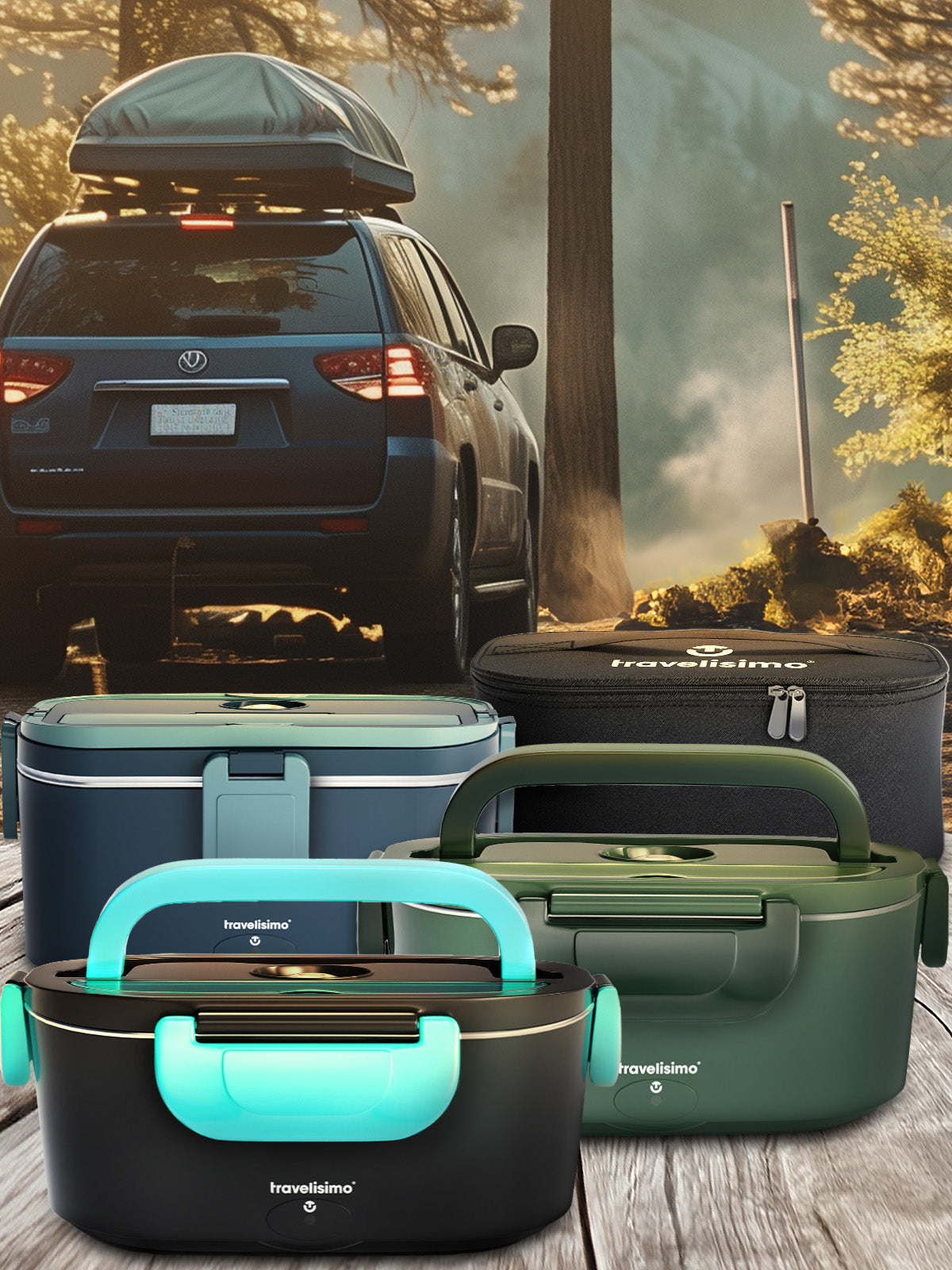
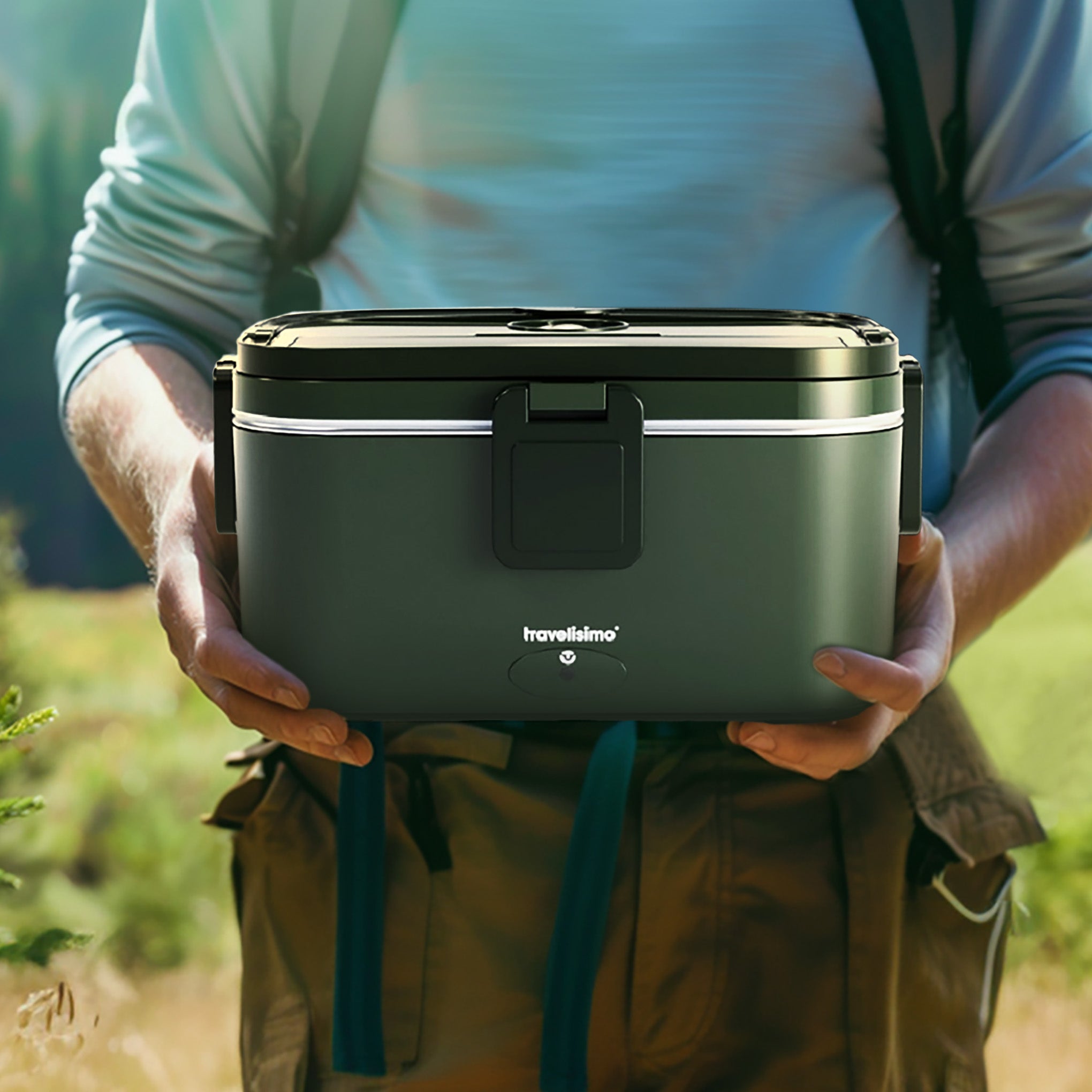
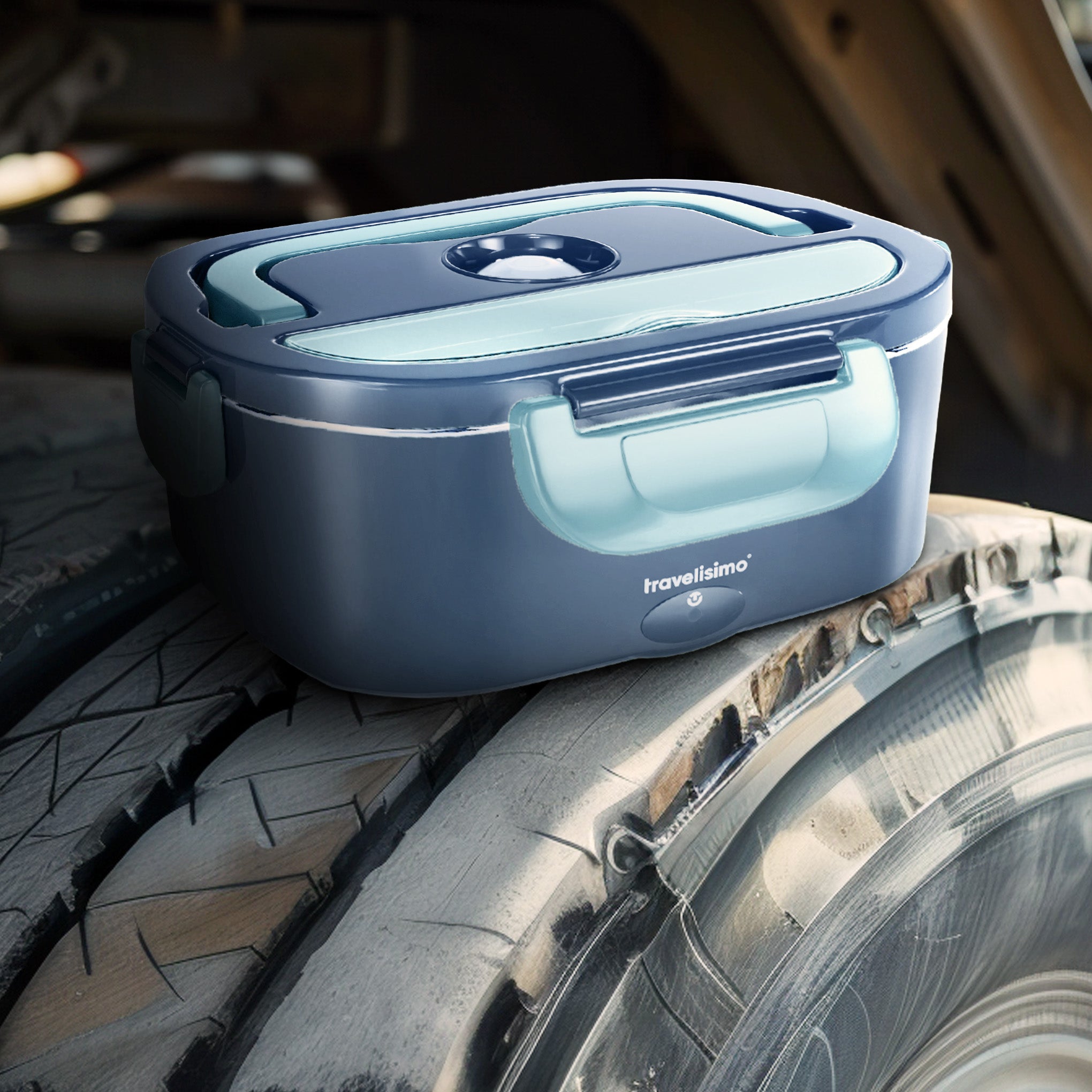
The result is the Monza, a cordless heated lunch box designed specifically for people who spend the whole day away from a kitchen.
What Makes the Monza Different
A 1.6-liter, 6.8-cup tray. That's roughly a third more than the 5.5-cup trays most of the category ships with. Protein, starch, and vegetables in one box. A real plate for a real appetite.
Up to 3–4 heating cycles per charge. Because PTC heating draws less power than a brute-force element, the same 24,000 mAh battery goes further. Miss a night on the charger and you still eat hot the next day.
Gentle, even PTC heating. No hot spots, no dried-out edges. Rice comes back soft. Sauce comes back together.
SS304 stainless steel tray. It doesn't hold odors, doesn't stain, doesn't leach anything into hot food, and goes in the dishwasher. A silicone seal keeps chili in the tray and off the seat.
A programmable timer. The two-minute routine: set it in the morning, eat hot at your break.
Everything included. Lunch box, SS304 leak-proof tray, stainless cutlery, 18W fast-charge adapter, USB cable, and an insulated carry bag. Nothing to buy separately.

$79.99
Shipped from the U.S. Lifetime warranty, 30-day money-back guarantee.
At $15 a day eating out, it pays for itself in about a week.
What Travelisimo Customers Say
I absolutely love this Travelisimo wireless lunch box. It heats my food evenly and keeps it warm for hours. The rechargeable battery is very convenient for work and travel. The size is perfect, and the quality feels durable and well-made. It's made lunchtime so much easier and more enjoyable. Highly recommended.
Ivonnis S. ★★★★★I bought these for my dad and brother. Both work for the pipeline and have crazy work hours, but that doesn't mean they shouldn't have healthy meals. They both love their lunch boxes and say they work great everywhere they go.
Tori ★★★★★If you are looking for quality and durability, this product is the right one. It has enough space for your lunches, it holds plenty of food, and it does not need recharging many times. The battery lasts.
Alba Z. ★★★★★What to Realistically Expect
The Monza is not a microwave, and it's worth being honest about what that means.
Gentle heat takes time — around 60 to 70 minutes for a full tray. That's why the timer matters: you set it an hour before your break, not when you sit down. Battery life depends on the weather: 3–4 cycles per charge in mild conditions, closer to 2 in a January cab, because lithium batteries lose capacity in the cold. And a full charge takes 6 to 7 hours, which is to say, overnight.
If what you want is something that boils food in five minutes, this isn't it. If what you want is to open your lunch box at noon, anywhere, and eat the meal you packed the way it was meant to taste — every day of the week — that's precisely what it was built to do.
Common Questions
Does it need an outlet or the truck's power?
No. You charge it overnight at home and it runs on its own battery all day. No cord, no cigarette lighter, no break room.
How long does it take to heat a meal?
About 60 to 70 minutes for a full tray. Set the timer an hour before your break and it's ready when you stop.
How many meals per charge?
Three to four in mild weather. Closer to two in freezing conditions, since lithium batteries lose capacity in the cold.
Will it make everything taste like last week's fish?
No. The tray is SS304 stainless steel, not plastic. It doesn't absorb odors or stain.
Can I put the tray in the dishwasher?
Yes. The tray and cutlery are dishwasher safe. Wipe the base by hand.
Will it leak in my bag?
The tray has a silicone gasket seal and is leak-proof when the lid is latched.
How long does shipping take?
REEMPLAZAR CON EL PLAZO REAL. Shipped from within the U.S.
What if I don't like it?
Send it back within 30 days for a full refund. No questions asked.
How long is the warranty?
Lifetime. Travelisimo covers the Monza for as long as you own it.
Where to Get One
The Monza is sold directly on Travelisimo's website for $79.99, shipped from the U.S., with a lifetime warranty and an unconditional 30-day money-back guarantee. Take it on your route or your site for a full week. If you're not eating hot lunch every day, send it back and get a full refund.
Run the math from earlier: at $15 a day eating out, the Monza pays for itself in about a week.
Seventy-five years after the steel lunch pail, the guy who packs his own food finally gets to eat it hot.
Advertising. Travelisimo is the seller of the Monza heated lunch box. Prices and availability subject to change.
© 2026 Travelisimo · Privacy Policy · Contact